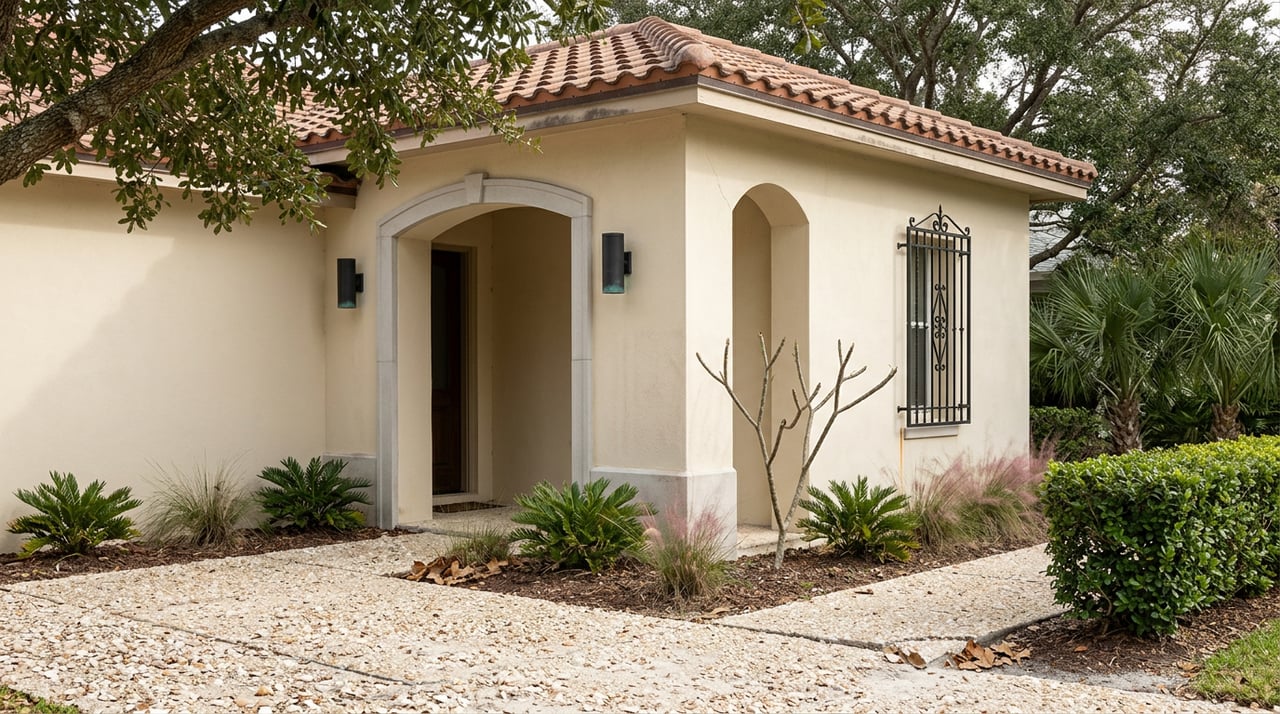
A buyer comparing two nearly identical Venice Island listings, both a few blocks from the beach, both built in the 1960s, will usually ask the same first question: what's the flood zone. It's the right instinct for most of coastal Florida. On Venice Island, it's often the wrong question to lead with.
Most Florida barrier islands share a predictable profile. Low, flat, and mapped almost entirely into FEMA Special Flood Hazard Areas, which is why insurance premiums and renovation budgets on islands like these tend to be governed by one number: the 50 percent rule. Venice Island doesn't follow that pattern as cleanly. The island sits unusually high for a barrier island, with some blocks reaching 15 feet or more in elevation just a short walk from the sand. A meaningful share of the island's residential parcels sit outside any mapped flood zone entirely, while other barrier islands along the Gulf are overwhelmingly inside one. That single geographic fact changes which rulebook actually decides what a buyer can do to a house here, and it isn't the one most people bring with them.
The Assumption Worth Checking First
The standard due diligence sequence for a Gulf Coast barrier island purchase goes something like: confirm the flood zone, get an elevation certificate, price the insurance, then plan the renovation budget around the 50 percent Substantial Improvement rule. That sequence assumes the flood zone is the binding constraint. On Venice Island, for a large share of the housing stock, it isn't. The constraint that actually governs what you can change on the outside of the house is a design review process tied to a 1920s city plan, and it applies whether or not the parcel sits anywhere near a flood zone.
That doesn't mean flood zone status stops mattering. It means the two questions need to be asked separately, and in a specific order, because the answer to one doesn't tell you the answer to the other.
What The Elevation Actually Buys You
For the parcels that sit outside the mapped floodplain, the practical effect is straightforward. There's no FEMA-triggered requirement to elevate the structure, and no 50 percent cap forcing a homeowner to choose between a partial renovation and a full compliance rebuild. A kitchen gut, a whole-house renovation, an addition, all of it can proceed on a normal contractor timeline without the value math that governs flood zone properties elsewhere on the coast.
For the interior stretch of the island where ground elevation drops and the parcels do carry an AE designation, the calculation looks different, and it's worth naming precisely because the City of Venice publishes the mechanics rather than leaving it to interpretation. Under the city's floodplain management rules, once the cost of restoring or renovating a structure equals or exceeds 50 percent of the building's market value before the work began, the entire structure has to come into compliance with current flood code, including elevation to the Design Flood Elevation, which the Florida Building Code sets as the Base Flood Elevation plus one foot of freeboard. The 50 percent threshold is calculated against the structure alone, not the land, and it includes labor, not just materials.
Here's what that looks like in practice on two otherwise comparable homes:
| Parcel outside the mapped flood zone | Parcel inside an AE flood zone | |
|---|---|---|
| FEMA elevation requirement | None triggered | Lowest floor must reach Base Flood Elevation plus one foot of freeboard if renovation crosses the threshold |
| Renovation cost cap | No FEMA-imposed cap | Roughly 50 percent of the structure's pre-renovation market value, cumulative |
| What still governs exterior changes | Architectural Review Board, if inside a design district | Architectural Review Board, if inside a design district |
The last row is the point. Flood zone status changes one column. It doesn't change the other.
The Escape Valve Almost Nobody Asks About
There's a third path that most buyers never learn exists until they're already mid-renovation, and it's specific enough to Venice that it's worth naming directly. The city maintains a Local Register of Historical Resources, separate from the Architectural Control Districts, established in 1987 under the city's Historic and Architectural Preservation Board. A property doesn't have to sit inside the Historic Venice or Venetian Theme district boundaries to qualify. What it has to do is meet the criteria for historic, architectural, or cultural significance, which can include being from the 1926 to 1929 John Nolen era of the city's development or from any other period the board finds meets the standard.
The benefits attached to Local Register status are concrete. A 10-year ad valorem tax exemption on qualified improvements. Designation as conforming for zoning purposes regardless of current regulations. And, most relevant to the flood conversation, the ability to restore a property in a floodplain even if the cost exceeds 50 percent of its assessed value, which the standard National Flood Insurance Program does not otherwise permit for properties that aren't on the Register. For an older AE-zone home that would otherwise be boxed in by the 50 percent rule, this is the mechanism that changes the math, and it's one that requires an application to the city rather than something that happens automatically because a house is old.
The Rulebook That Actually Limits What You Can Build
Set the flood zone question aside for a moment and consider the design layer, because this is the one that touches almost every meaningful exterior change on the older parts of the island regardless of elevation. City planner John Nolen laid out Venice's original plan between 1926 and 1929 in a Northern Italian Renaissance interpretation of the broader Mediterranean Revival style popular during Florida's land boom years. To protect that character, the city established the Historic and Venetian Themed Districts along with an Architectural Review Board, and any new construction or exterior alteration inside those district boundaries has to clear that board before work begins.
The process is specific. An applicant submits an Architectural Review Board application along with fourteen sets of plans and specifications, pays the filing fee, and has to hit the submittal deadline on the board's published calendar rather than applying whenever the contractor is ready. Roofing materials, window styles, color choices, additions, all of it gets evaluated against the district's design guidelines before a permit moves forward. This applies to homes whether they sit in a flood zone or not, and it applies whether or not the owner has ever heard of the 50 percent rule.
For a buyer evaluating renovation potential on Venice Island, the due diligence sequence that actually matches how the rules work looks like this:
- Confirm the parcel's flood zone status and, if relevant, its Base Flood Elevation
- Separately confirm whether the parcel sits inside the Historic Venice or Venetian Theme district boundary
- If it's an older structure in a flood zone, ask whether it might qualify for the Local Register before assuming the 50 percent cap is fixed
- Budget renovation plans around whichever constraint actually applies, not the one that applies on a typical barrier island
What This Means For The Comparison You're Actually Making
If you're weighing Venice Island against other Gulf Coast barrier communities, the fair comparison isn't flood insurance line to flood insurance line. It's asking which rulebook governs the specific parcel you're looking at, because on this island the answer changes block by block in a way it doesn't on most barrier islands, where the flood zone answer is close to universal.
The current pace of the market backs up why this diligence is worth doing before an offer rather than after. Over the three months ending June 2026, homes across Venice sold at a median of roughly $409,000, essentially flat compared to the same period a year earlier, with typical listings drawing about two offers and reaching contract in around 66 days. That's not a market forcing rushed decisions. Venice Island itself has long traded at a premium above the broader Venice number, a function of walkability, limited land supply, and direct beach access rather than anything to do with which side of the flood line a given block sits on.
None of that premium tells you which board signs off on your renovation. Only the parcel does.
Frequently Asked Questions
If my Venice Island home isn't in a flood zone, do I still need approval to replace my roof? If the parcel sits inside the Historic Venice or Venetian Theme district boundary, yes. The Architectural Review Board's authority is tied to the district, not to flood zone status, so roofing material and design still require review regardless of elevation.
Can any homeowner apply for the Local Register of Historical Resources, or only homes from the Nolen era? The Local Register isn't limited to 1926 to 1929 construction. A property can qualify for other historical, architectural, or cultural significance as determined by the city's Historic and Architectural Preservation Board, and it doesn't have to sit inside an existing Architectural Control District to be eligible.
Does being outside a flood zone mean I can skip flood insurance entirely? Flood insurance requirements are tied to your lender and your specific FEMA designation, not to general island geography. A property just outside a mapped zone can still carry risk and can still make sense to insure voluntarily. Confirming the actual designation on the specific parcel is the only way to know for certain.
Renovation math and design review rules like these are exactly the kind of detail that gets missed when a listing is priced off a portal estimate instead of a true comparison of what a specific parcel can and can't support. If you're weighing a purchase or a renovation on Venice Island and want a straight read on what applies to the address you're actually considering, Carolyn Yates is a good place to start that conversation. Let's Connect.